Introduction
Artificial intelligence, or AI, has existed for decades, but it is only recently — with the arrival of tools like ChatGPT — that it has taken on an almost central place in many people’s lives. We hear about it everywhere, we wonder how it might help us, and what its dangers are.
In this article, I invite you to explore how artificial intelligence and new technologies, such as virtual reality headsets, can transform mental health care. Whether you are simply curious, someone seeking help, or even a health professional, you will find ideas here to better understand these tools and their usefulness.
Imagine being able to face your fear of heights in a virtual world, in complete safety. Or chatting at any hour with a kind virtual assistant, ready to listen without ever judging you. What seemed like science fiction a few years ago is now becoming reality.
And that’s good news: according to the World Health Organization, 1 in 8 people worldwide suffers from mental health disorders. Yet there is a severe shortage of professionals to meet all these needs. Psychological care is often expensive, lengthy, not always reimbursed, and many people don’t have the time or energy to commit to therapy. In this context, innovation is urgent. AI and virtual reality open up new solutions to make therapy more accessible and more tailored to each individual. For example, an app can provide anonymous 24/7 support without the need to travel, which makes seeking help much easier. Another possibility: treating phobias in a virtual environment, safer and less costly in terms of time and stress.
These technologies are gradually changing the way we view mental health care. First, they broaden access to treatment: even someone isolated or hesitant to consult can benefit remotely. Then, they make therapy more interactive and personalized: exercises can be adapted in real time according to the person’s reactions, or a tailor-made setting can be created. Finally, for some people, talking to an AI is less intimidating than to a human, because there is no fear of judgment. Some patients say they feel freer to confide in a “neutral” robot than in a traditional therapist. Of course, AI and VR do not completely replace conventional therapies, but they complement them by opening new ways of improving wellbeing and working on oneself.
What is Artificial Intelligence (AI)?
Artificial intelligence, or AI, is a computer program capable of imitating certain human abilities. In other words, it’s like a machine that has been taught to think, almost like a human. For example, AI can learn to speak, write, do calculations, or recognize images. Unlike traditional software, AI has the ability to improve: it can be trained by humans, and sometimes even learn on its own depending on the data it receives.
Without always realizing it, we already use AI in our daily lives. For example:
- your smartphone recognizing your face to unlock,
- a video game where enemies adapt to your actions,
- the app recommending videos to you,
- or the autocorrect that fixes your spelling mistakes.
All of this is artificial intelligence!
As for me, I use AI a lot in my daily life, especially for my studies and my work. For example, when I need to write a cover letter for an internship: without AI’s help, it would easily take me three hours, but with its help, I spend barely fifteen minutes! And this article? Well, AI also gave me a hand to make it clearer, shorter, and easier to read.
What is Virtual Reality (VR)?
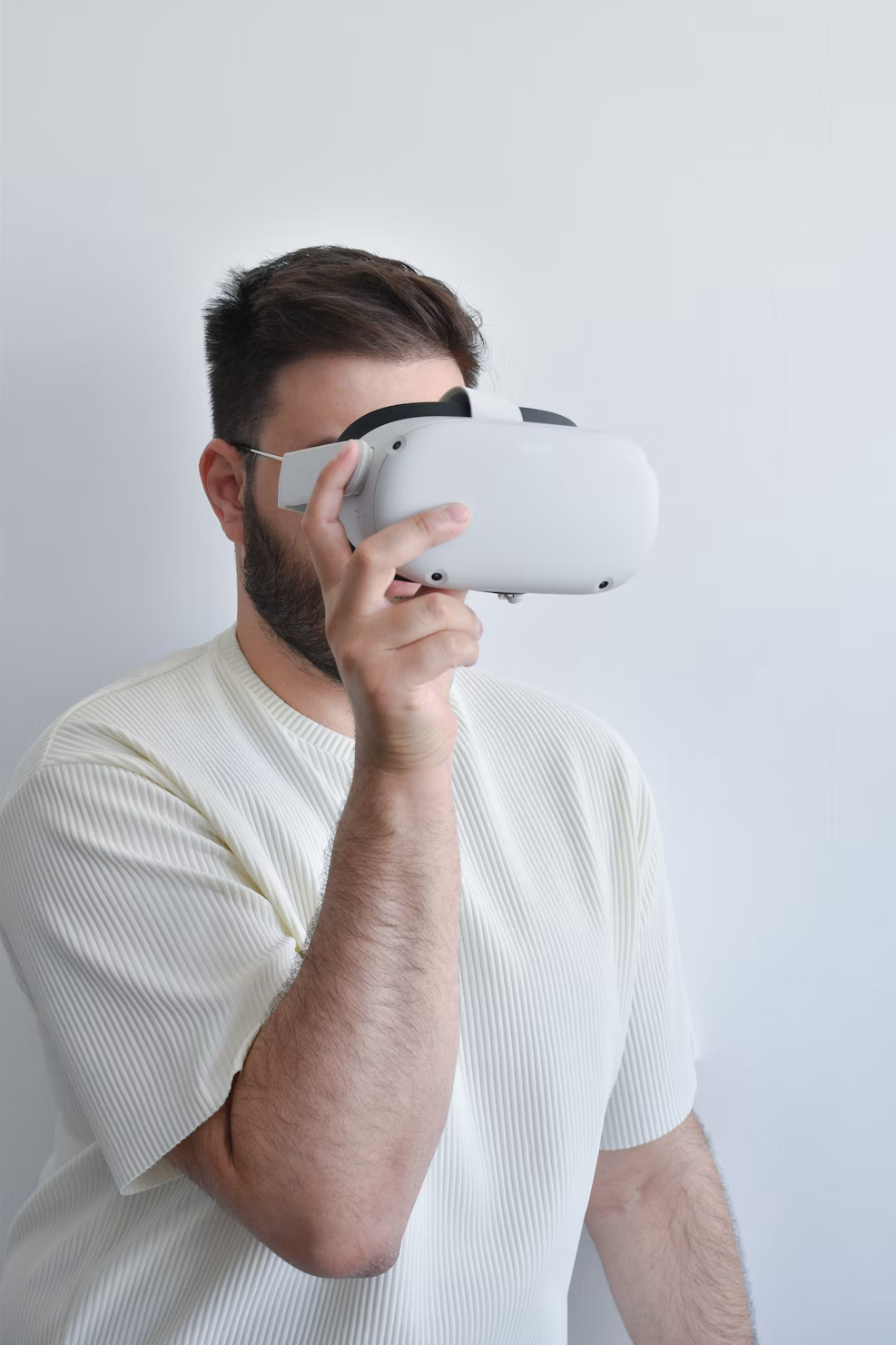
Virtual reality, or VR, is a technology that immerses a person in an artificial world created by a computer. Concretely, you put on a special headset over your eyes, and suddenly — you’re projected into a three-dimensional universe, as if you were really there.
This virtual world can look like a real place, such as a street or a forest, or be completely imaginary. The experience relies mainly on sight and hearing: you see a 360° landscape all around you, you hear corresponding sounds, and your brain is tricked… it truly believes you are there!
To enjoy VR, you use a virtual reality headset. Inside, there is a small 3D screen for each eye, creating a sense of depth. Sensors track your head movements, so if you turn your head left or right, the virtual scene follows exactly as in real life.
How is AI used in therapy?
One of the most widespread uses of artificial intelligence in mental health is therapeutic chatbots. These are conversational agents, available 24/7, that can talk with patients and provide support. Some, like Woebot or Wysa, use cognitive-behavioral therapy (CBT) techniques: they might propose breathing exercises, help reframe negative thoughts, or simply offer a listening ear without judgment.
These tools have several advantages: they are always available, they allow people to talk about their difficulties discreetly, and they can remove certain barriers linked to shame or the cost of consultations. Of course, they do not replace a real human therapist, but they can complement therapy and support a person between sessions.
Are these chatbots effective?
A recent randomized controlled trial (a scientific experiment where participants are randomly assigned to groups — for example, one testing a treatment and one not — to allow fair and reliable comparison) conducted by Heinz and colleagues in the United States in 2025, published in The New England Journal of Medicine, addressed this question. They evaluated the effectiveness of a therapeutic chatbot called Therabot on 104 participants suffering from depression, generalized anxiety, or at risk of eating disorders. They used Therabot for 4 weeks. Results showed that patients’ symptoms decreased significantly compared to those on a waiting list, with moderate to strong effects. The researchers note, however, that these tools still require cautious study and more research on long-term effectiveness.
A Chinese systematic review and meta-analysis, pooling results from 18 randomized controlled trials with around 3,477 participants, conducted by Zhong and colleagues and published in 2024 in the Journal of Affective Disorders, found that chatbots brought modest but significant improvements in depressive and anxious symptoms after several weeks of use, especially after 8 weeks. However, at 3-month follow-up, they observed no sustained benefits. The authors also noted limitations: for example, chatbot quality varies, and the studies sometimes lacked diversity in patient profiles.
AI can also help track mood daily. Some apps invite users to record their mood each day, making it possible to track progress with or without therapy in parallel.
There is also research into AI’s ability to detect early signs of crisis. Two American scientists, Mansoor and Ansari, published a prospective observational study in 2024. They created an AI capable of analyzing social media posts, likes, and even word choices to detect signs of an impending crisis. Their model achieved 89% accuracy in spotting these warning signs.
How is VR used in therapy?
Have you ever tried a VR headset? Personally, I have! And to be honest: I’m quite sensitive, and the experience quickly made me nauseous. I couldn’t handle the headset! But enough about me — let’s look instead at VR’s role in therapy.
In therapy, virtual reality is mainly used to help patients face their fears gradually and safely. The idea is to help the person tame their fears step by step, in a controlled virtual environment. For example, someone with a panic fear of flying can, with a VR headset, sit virtually in an airplane, hear the sound of the engines, see the sky through the window… all while remaining in the therapist’s office. This allows the brain to get used to the situation and reduce fear without any real risk.
This method is used to treat many phobias: fear of heights, spiders, driving, public speaking, etc. The advantage is that the therapist can adjust the difficulty at any time and stop the exercise if it becomes too intense. The patient knows they can remove the headset at any moment, which is very reassuring and makes therapy more acceptable. Plus, the same scene can be repeated multiple times, which is often difficult, even impossible, in real life (like taking a flight just to practice!).
But does it really work?
Theresa F. Wechsler, Franziska Kümpers, and Andreas Mühlberger, from the Institute of Psychology at the University of Regensburg in Germany, conducted a meta-analysis published in 2019. They studied 371 people suffering from specific phobias, social phobia, and agoraphobia. Result: virtual reality exposure therapy is almost as effective as “in vivo” exposure (i.e., real-life exposure, where the person faces fears in real situations with a therapist present). They found a slight advantage for real-life exposure in social phobias, but overall, VR remains a very promising tool — effective, practical, and safe.
VR has also been tested for treating post-traumatic stress disorder (PTSD). A meta-analysis published in 2020 by Eshuis and colleagues (438 participants) concluded that VR exposure therapy is more effective than no treatment, and just as effective as other traditional psychotherapies. However, the researchers emphasized that study quality is still uneven and that further research is needed, with more rigorous methods and larger samples, to better confirm these results and monitor possible side effects.
In summary, VR already shows very promising possibilities, though more work is needed to fully validate its effectiveness in all cases.
Advantages of these technologies
These technologies offer several advantages:
Better access to care
They open the door to wider support, even remotely. A chatbot or support app can help someone who has no therapist nearby or cannot easily travel. With VR and AI, therapy becomes more accessible, particularly for those living in remote areas or without qualified professionals. Moreover, AI can track someone’s daily state through their smartphone and quickly detect drops in mood, allowing earlier intervention. Chatbots are available day and night, outside consultation hours: they can provide support between sessions.
More personalized care
AI is very good at analyzing data and adapting therapy to each person. For example, by tracking a patient’s progress, it can identify which exercises help most and suggest repeating them. We are seeing increasingly personalized therapy: some programs even adapt their messages according to age, preferences, or sensitivity.
Less stigma
For many, using a digital tool is less intimidating than walking into a clinic. Talking with an avatar or chatbot at home remains discreet and avoids the embarrassment or shame some still feel about “seeing a therapist.” The relative anonymity of technology can therefore encourage more people to seek help without fear of being judged.
A real complement to traditional methods
AI and VR do not replace traditional therapies; they enrich them. For example, someone may continue weekly sessions with their psychologist while using a chatbot to keep an emotional journal or practice breathing exercises every evening. This complements therapeutic work and gives the professional additional insights for the next session.
Limitations and precautions
Even though AI and VR open up exciting possibilities in mental health, it’s important to remember that they are not perfect. Like any tool, they must be used with caution, especially in such a sensitive field as psychological care.
In an article published in 2023, Khawaja and Bélisle-Pipon, from Simon Fraser University in Canada, remind us that therapeutic chatbots offer only a very limited therapeutic relationship, and that “the idea that these chatbots can replace a human therapist is a façade that can affect motivation to seek social support and treatment, creating an excessive dependence on these technologies.”
Similarly, in their 2023 systematic review (a study that doesn’t conduct new experiments, but compiles and analyzes all published research on a given topic following strict methods), Lundin, Yeap, and Menkes highlighted the importance of human supervision to ensure the safety of technological interventions in mental health, particularly regarding the risks of VR.
In this study, they analyzed 73 clinical studies using VR in psychiatry: only 7 reported adverse effects (e.g., worsening of symptoms), 21 claimed there were none but overlooked VR’s negative effects — mainly cybersickness. Cybersickness is a bit like motion sickness… but caused by VR. When using a VR headset, the brain perceives movement, but the body stays still. This mismatch can cause nausea, dizziness, headaches, or fatigue — much like being on a car or boat. Finally, they found that 45 studies (more than 60%) did not mention potential adverse effects at all. These results suggest a concerning underreporting of negative reactions during VR-assisted therapies.
The authors conclude that it is urgent to improve detection and reporting of such side effects to ensure patient safety. This requires the presence and vigilance of human professionals to monitor VR sessions (or chatbot use), adjust exposure if necessary, and intervene in case of distress, in order to avoid inappropriate exposure or lack of response in a crisis.
And of course, all of this also raises important ethical questions. These digital tools may record a great deal of personal information: what you feel, what you say, your physical reactions… It is therefore essential that this data is protected and that you know exactly what is collected, by whom, and for what purpose. Respect for privacy and medical confidentiality must remain an absolute priority.
To conclude, these technologies should be used under the close supervision of a mental health professional, especially for people with severe disorders. Digital tools have their limits. For example, a chatbot, no matter how well programmed, may miss a crisis situation. AI and VR can offer great things, but they should never be used alone or lightly. They are complements, not replacements. And when properly supervised, they can truly make a difference.
Conclusion
Artificial intelligence and virtual reality open up exciting perspectives for enhancing mental health therapies. They make certain treatments more accessible, more engaging, and more personalized, supported by increasingly solid scientific evidence.
Of course, these tools are not miracle solutions: they do not replace humans, but they complement them, supporting the therapist’s work. With professional guidance and ethical use, AI and VR can become true allies in caring for mental health. Used wisely, these new technologies have the potential to bring hope and support to those who need it.