Who is this article for? Sometimes, a film says exactly what we cannot put into words ourselves. And that feels good. This article is for people experiencing psychological distress, therapists, and anyone curious about how cinema can become a tool for introspection, transformation, and emotional support—whether alone or in a group.
What if a film could help us feel better? For several decades now, cinema has gone beyond mere entertainment. It can move us, make us reflect, and awaken awareness. Sometimes, a scene, a line, or a character suddenly resonates with what we feel but cannot express. This emotional resonance lies at the heart of cinematherapy, an approach used individually or in groups to encourage expression, perspective-taking, and sometimes, personal transformation.
What is cinematherapy? Cinematherapy (or film therapy) refers to the use of films or film excerpts within a therapeutic setting. It can be offered: – in individual or group sessions, – to address themes such as trauma, anxiety disorders, depression, or relational conflicts, – or as a tool for psychoeducation.
The goal is not to analyze the film, but to use what it triggers within as a starting point to explore one’s emotions, thoughts, or experiences. It’s not “just” watching a film. It’s experiencing it, processing it, and seeing what it awakens in us.
What does scientific research say?
Powerful emotions A meta-analysis conducted in Spain by Fernández-Aguilar et al. (2019), published in PLOS ONE, compiled results from 43 experimental studies with adults (Spain, United States, Canada). It showed that films are among the most effective tools for inducing authentic emotions (positive or negative) in laboratory settings. These reactions are reproducible and measurable, making cinema a reliable tool to activate emotion in therapy.
A promising therapeutic tool A systematic review led by the University of Pavia in Italy (Sacilotto et al., 2022), published in Frontiers in Psychology, analyzed 38 qualitative and experimental studies across several European countries. It concluded that cinema: – fosters self-understanding, – stimulates empathy, – and can trigger lasting cognitive and emotional changes, particularly among people living with anxiety disorders, autism, or post-traumatic experiences.
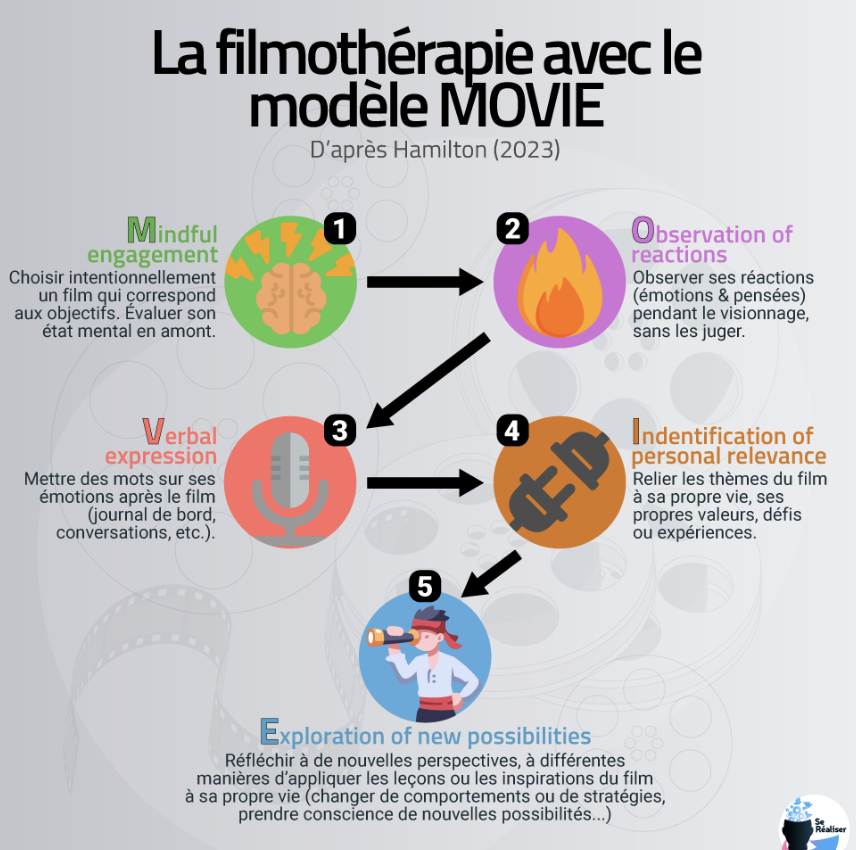
A guided method: the MOVIE model The MOVIE model, proposed by Hamilton (2023) [Unverified], is a structured approach to integrating cinema into psychotherapy, particularly with people who have experienced trauma.
Letter
Step
Therapeutic objective
M
Mindful engagement
Choosing a film consciously, based on current emotional or therapeutic needs. Taking a moment to assess one’s mental and emotional state before watching.
O
Observation of reaction
Carefully observing emotional, cognitive, and physical reactions during the viewing, without judgment.
V
Verbal expression
Putting emotions into words after the film, either in writing (journal) or verbally (with a therapist, support group, or friend).
I
Identification of personal relevance
Connecting the film’s events and themes to one’s own life, reflecting on how it mirrors personal challenges, values, or experiences.
E
Exploration of new possibilities
Considering new perspectives and applying lessons or inspirations from the film to one’s own life (behavioral changes, problem-solving strategies, greater awareness).
At home: how to do it? And what if you want to try it on your own at home?
Choose a film that moves you or intrigues you. Take a moment to ground yourself before watching. After the film, write down what you felt, what stayed with you, what spoke to you. You can then talk it over with someone you trust, or within a support group.
Films and their uses in group or individual therapy
Film
Therapeutic themes
Example of patient situation
Possible effects on the patient
Trailer link
Good Will Hunting(1997)
Trauma, attachment, therapeutic alliance
Young man with family estrangement, distrustful of therapy, refusal of vulnerability
Feeling “seen,” opening up to the therapeutic relationship, beginning of emotional verbalization
Conclusion Cinema, as an emotional mirror, becomes a therapeutic tool that is both accessible, powerful, and flexible. When used wisely, it can nurture introspection, ease resistances, and open new paths for psychological transformation. Cinematherapy is not meant to replace conventional therapy, but it can be a powerful catalyst.
Want to give it a try? If you feel the desire to explore certain emotions through films, don’t hesitate to join a support group or a therapeutic group. You can check out the groups available on the Healing Together platform. You may find a caring space where the stories of cinema resonate with your own.
💛 Because sometimes a film can say what words don’t dare to express yet, I hope these insights will help you explore, feel… and maybe, begin to heal. – Apolline, from Healing Together 💛
References
Fernández-Aguilar, L., Navarro-Bravo, B., Ricarte, J., Ros, L., & Latorre, J. M. (2019). How effective are films in inducing positive and negative emotional states? A meta-analysis. PLoS ONE, 14(11), e0225040. https://doi.org/10.1371/journal.pone.0225040
Sacilotto, E., Salvato, G., Villa, F., Salvi, F., & Bottini, G. (2022). Through the Looking Glass: A Scoping Review of Cinema and Video Therapy. Frontiers in Psychology, 12. https://doi.org/10.3389/fpsyg.2021.732246
Dumtrache, S. D. (2014). The Effects of a Cinema-therapy Group on Diminishing Anxiety in Young People. Procedia – Social and Behavioral Sciences, 127, 717-721. https://doi.org/10.1016/j.sbspro.2014.03.342
This article was created by our former collaborator, Rawya Benaissa. When screens take over We all sometimes get carried away by certain habits. With screens, it’s even easier. For young children, teens, and young adults, the phone has become a…
Who is this article for? This article is for you if you feel a bit lost, overwhelmed, or simply tired of something that keeps looping in your head. If you don’t really have the energy or desire to start a…
Every science is constantly evolving — and psychology is no exception. Almost every day, a new discovery emerges. But where do we stand with psychology today? Currently, many new fields are appearing in psychology, especially with the arrival of high-performance…