Aging isn’t necessarily painful… but sometimes, we feel alone
As the years go by, things change.
The children move out.
Friends aren’t around like they used to be.
The body grows tired.
Sometimes the mind, too.
And even if everything isn’t bad, you still feel that something is missing.
If you’re here, it might be because you feel this too.
That sense of loneliness, that need for connection, that fatigue you don’t always dare to name.
You are right to look for a space for yourself.
A space where no one will simply say: “It’s normal at your age.”
Who is this article for?
This article is for you if:
You are retired or transitioning to retirement
You feel isolated, are experiencing grief, low spirits, or emotional fatigue
You would like to reconnect, to find a space for listening, sharing, and human connection
You sometimes feel forgotten, left out, or unheard
You don’t know where to start to find support
I am writing this article for you, as I would if we were sitting together — gently — to help you explore how support groups and group therapy can help you feel connected to others again.
In Belgium, many resources can support you
When we start looking for help to cope with loneliness or emotional distress, we often don’t know where to begin.
And yet, there are many ways to access support:
Public mental health networks (“107” networks): they offer individual therapy, peer groups, psychological support, and group activities — accessible even without a referral.
Local platforms: they list professionals (psychologists, therapists, peer groups) by region.
Support groups and group therapy: these spaces help you build connections, express your feelings, and break isolation.
Why can a group really help?
Numerous scientific studies show that support groups and group therapy have a very positive impact on the well-being of older adults facing loneliness or emotional distress.
For example, a systematic review — a rigorous analysis of published studies — was conducted by Cattan, White, Bond, and Learmouth (2005) from the University of Newcastle (UK), and published in Health Promotion International.
This review examined 30 studies on group interventions aimed at reducing social isolation and loneliness in older adults, across various Western countries.
The results show that group interventions help:
Reduce perceived loneliness
Strengthen sense of belonging
Improve emotional well-being
Encourage the creation of new social connections
In addition, an experimental study conducted by Haslam, Cruwys, and Haslam (2014), researchers at the University of Queensland (Australia), published in Social Science & Medicine, showed that participating in social groups strengthens social identity — that is, the feeling of being part of a collective — which is recognized as a key factor in supporting psychological well-being in older adults.
Support group, group therapy — what’s the difference?
A support group is a space for free conversation among people facing similar life experiences (grief, isolation, emotional fatigue…).
You share, listen, connect — without obligation or pressure.
Group therapy is a more structured process, guided by a professional.
It allows for deeper exploration of what you are feeling, carrying, and wish to release.
Both are complementary: one helps you not feel alone, the other helps you move forward with confidence.
And what about Healing Together?
At Healing Together, we believe that human connection remains vital at every age.
That’s why we help promote support groups and group therapy led by trusted professionals.
We highlight:
Intergenerational support groups or groups dedicated to seniors — online or in person
Gentle, accessible group therapy facilitated by kind and experienced professionals
Spaces where you can talk, listen, and feel connected again
You don’t need to explain everything.
You simply need to be welcomed.
But what exactly is a “network”?
A mental health network is not a single building.
It is a group of professionals and services that work together in your region to support people facing psychological difficulties.
In a network, you can find:
Psychologists
Social workers
Nurses
Facilitators of peer groups
And sometimes partners in community health centers, day centers, or local organizations
You can contact a network without a medical referral, even if you simply want to ask questions or seek advice.
Mental health networks near you
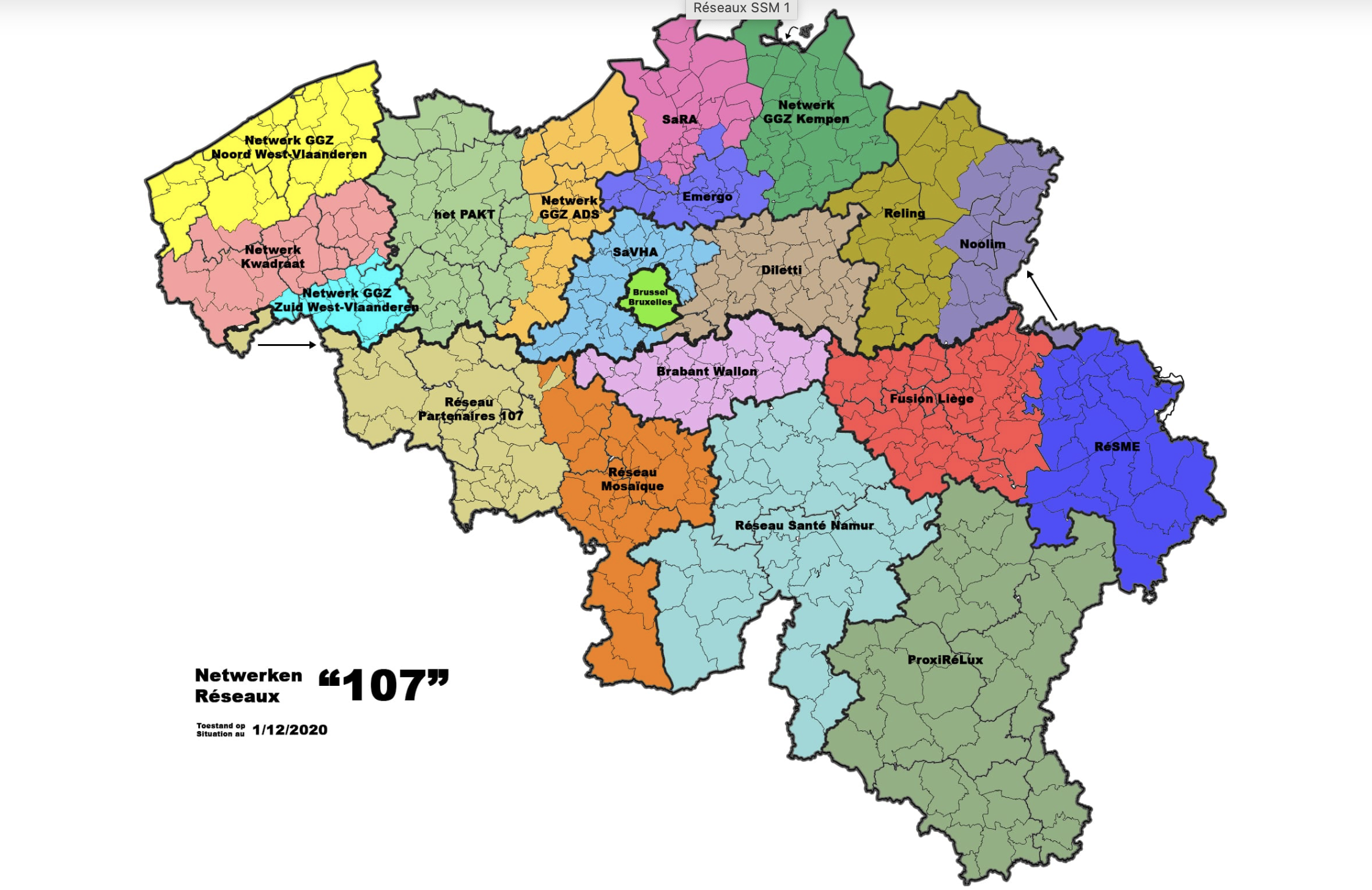
Here are the “107” networks that can support you in Belgium:
For example, PsyBru is a mental health network based in Brussels. It connects individuals with local professionals and services offering psychological support, therapy programs, crisis care, and peer groups.
💡 Click on the name you’re interested in — you’ll be redirected to their website.
📍 A map to help you locate your network
The network map shared here comes from the reference site psy107.be, which compiles official information about mental health networks in French-speaking Belgium.
Other platforms to explore
In addition to the 107 networks, there are other complementary platforms that can help you discover spaces for dialogue and support.
In addition, you can also explore Kalima, a platform dedicated to circles of speech, available both online and in person.
Kalima offers:
Thematic circles focused on emotional expression, parenting, and personal experiences,
Open collective spaces for everyone,
Workshops on active listening and mindful communication.
It is a complementary resource that allows you to explore supportive spaces in a preventive and caring way.
Kalima’s circles are suitable for anyone seeking connection, sharing, or looking to complement a therapeutic process.
What can you do now?
You might still be unsure.
You may be wondering which type of group would suit you, or where you should start.
No worries: there are many possible paths, and the most important thing is to choose what resonates with you the most right now.
If you are looking for an open and supportive space to express your feelings and hear the experiences of others, you can join Kalima’s circles of speech (online or in person).
If you prefer a more structured approach, within support groups or group therapies led by professionals, the Brussels Platform for Mental Health (PBSM) is an essential resource for discovering local initiatives.
For an overview of mental health services in your area, you can consult the 107 networks map.
If you are considering individual support, or if you would like some guidance, you can turn to local platforms or simply contact us directly.
Whatever your situation, there is no right or wrong choice.
The most important thing is to move forward at your own pace and find the spaces where you feel comfortable.
Conclusion
It is never too late to feel supported.
It is never too late to build connections.
It is never too late to take care of yourself.
In Belgium, there are many solutions: public networks, support groups, group therapy, committed professionals.
You do not have to go through this period alone.
Research shows: sharing in a group, building connections, rediscovering a sense of belonging — these are key drivers of well-being, at any age.
And if today, this simple article was the start of a new path?
You can start gently: by exploring support groups and group therapy available near you or online, in whatever way suits you best.
You can also browse our other themed articles, to learn more and choose the kind of support that feels right for you.
One step, even a small one, can open unexpected paths.
You are not alone.
And you, too, deserve a space to be heard, supported, and connected.
💛 Building connections is already taking care of yourself. 💛
This article was created by our former collaborator, Rawya Benaissa. When screens take over We all sometimes get carried away by certain habits. With screens, it’s even easier. For young children, teens, and young adults, the phone has become a…
Who is this article for? This article is for you if you feel a bit lost, overwhelmed, or simply tired of something that keeps looping in your head. If you don’t really have the energy or desire to start a…
Every science is constantly evolving — and psychology is no exception. Almost every day, a new discovery emerges. But where do we stand with psychology today? Currently, many new fields are appearing in psychology, especially with the arrival of high-performance…