It’s for you, perhaps, if you’re feeling unwell without really knowing why.
For those living with an exhaustion that won’t go away, a vague sadness, an overwhelming flood of emotions… or even numbness.
For those who hesitate to seek help because they wonder if it’s “serious enough,” because they can’t find the words, or because they simply don’t know where to start.
This article is for anyone feeling a little lost with what they’re going through — regardless of age, situation, or life journey.
Whether you’re a young adult, a parent, a senior, a student, an employee, someone between jobs, in a precarious situation, or going through a life transition… here you’ll find guidance and ideas to move forward at your own pace.
In Belgium, there are many resources available
When you don’t know exactly what’s wrong, it can feel even harder to know where to turn.
Here are the main options that can help:
Public mental health networks (“107 networks”): they offer first contact, individual support, and support groups. You can contact them even without a referral, even if you don’t know exactly what you need.
Local platforms: they list mental health professionals and groups in your region.
Support groups and group therapy: these spaces help you find words, avoid isolation, and move forward at your own pace.
Why can a group really help when you don’t know what’s going on?
You don’t need a diagnosis to benefit from a group.
Research clearly shows that support groups and group therapy provide positive effects even when people are experiencing vague emotional distress, emotional fatigue, or mild mood difficulties.
For example, a meta-analysis — an analysis that combines results from multiple studies to draw solid conclusions — conducted by McDermut, Miller, and Brown (2001) at Brown University (USA), published in the Journal of Clinical Psychology, examined 48 studies on the effectiveness of group therapy for depression.
The findings show that group therapy significantly reduces symptoms of mild to moderate depression, improves quality of life, and strengthens feelings of social connection — including for people without a formal diagnosis.
Additionally, in their renowned reference book, The Theory and Practice of Group Psychotherapy (6th edition, 2020), Irvin D. Yalom (Stanford University, USA) and Molyn Leszcz (University of Toronto, Canada) emphasize that group therapy fosters:
emotional expression
normalization of feelings
breaking isolation
creating a climate of mutual support,
which promotes well-being, even for those who haven’t yet been able to name what they are experiencing.
As Yalom and Leszcz show, these benefits do not depend on a diagnosis or in-depth analysis — they stem from universal human dynamics.
The simple act of expressing what you feel, hearing that others are going through similar experiences, no longer feeling alone, and receiving support can create an environment that promotes healing.
It often helps to “peel back the layers” of emotional fog and gradually gain more clarity about what you’re going through.
This is why a group can be such a valuable first step — especially when you feel lost or haven’t yet been able to put your distress into words.
Support group or group therapy: what’s the difference?
Group therapy, led by a therapist, helps you work in a small group on topics such as anxiety, self-esteem, trauma, or general distress — within a structured framework with clear progression.
Support group is a more open space, facilitated by a professional or a trained peer. You can simply come to listen, to share what you’re carrying, and to feel less alone.
Both are complementary:
One helps you avoid isolation; the other helps you explore things in greater depth.
But what exactly is a “network”?
A mental health network isn’t a single building.
It’s a group of professionals and services that work together in your region to support people experiencing psychological difficulties.
You’ll find:
psychologists
social workers
nurses
support group facilitators
and sometimes partners from local associations or community organizations.
You can contact a network even if you don’t know what you need yet.
They are there to listen to you, guide you, and help you find the right support.
Which networks can welcome you near where you live?
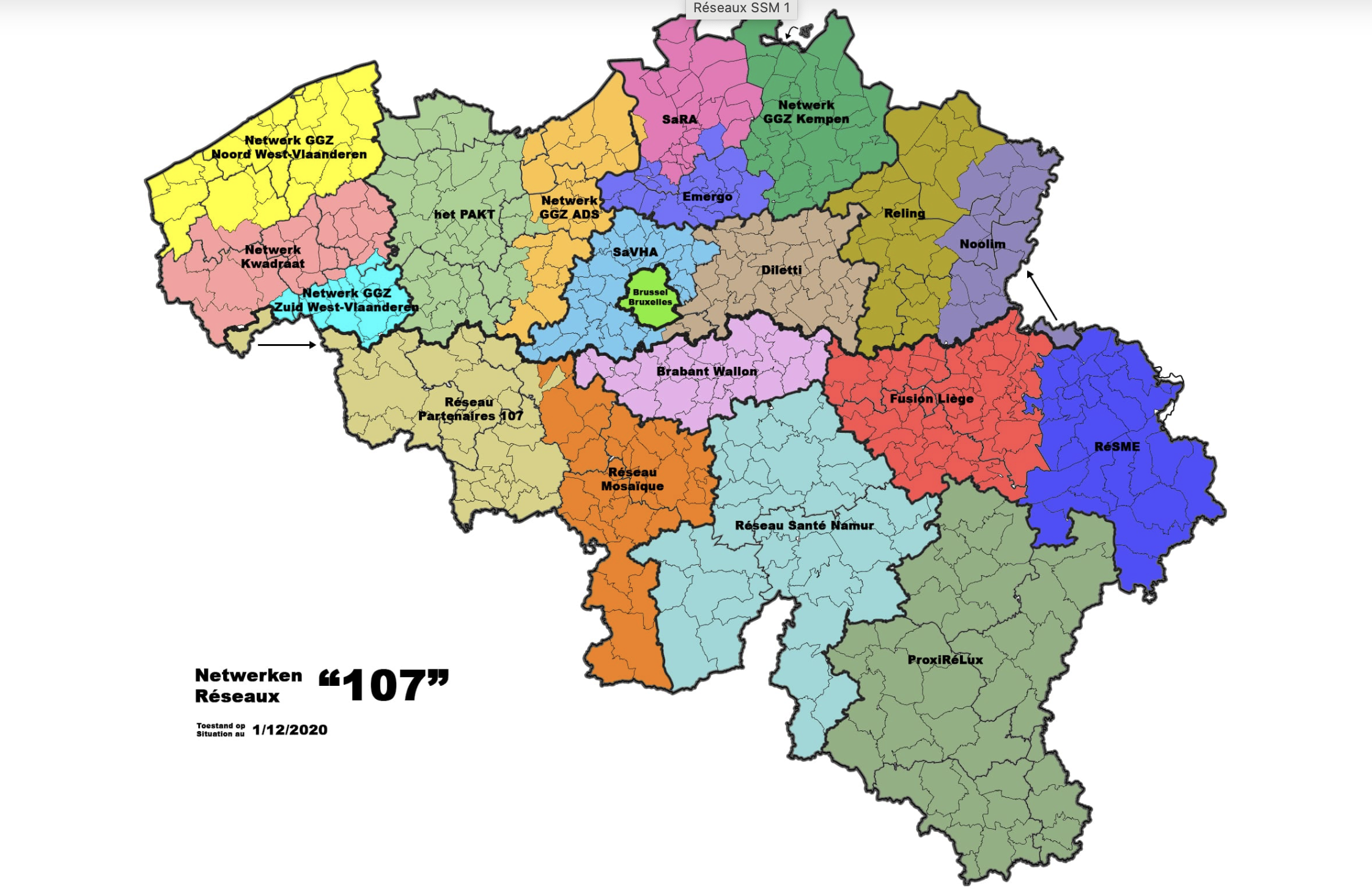
107 Networks for adults
These networks provide local, accessible mental health services, often free or low-cost.
For example, PsyBru is a mental health network based in Brussels. It connects people with local professionals and services offering psychological support, therapy programs, crisis care, and prevention.
💡 You can click on any name to be redirected to their website.
📍 You can also explore the interactive network map.
The map shared here comes from the official reference site psy107.be, which centralizes information about public mental health networks in French-speaking Belgium.
What about Healing Together?
At Healing Together, we welcome exactly this kind of uncertainty.
You don’t need to have everything figured out to start seeking support.
You come as you are.
We help raise awareness about support groups and group therapy offered by trusted professionals, online or near you.
These are spaces where people talk about what hurts, listen, breathe.
Sometimes you find words. Sometimes you simply learn not to feel ashamed.
We don’t create these groups, we highlight them so that you can access them more easily.
Other platforms to explore
In addition to the 107 networks, there are other complementary platforms that can help you discover support groups and spaces for dialogue.
In addition, you can explore Kalima, a platform dedicated to circles of speech, accessible both online and in-person.
Kalima offers:
Thematic circles focused on emotional expression, parenting, and personal experiences,
Open collective spaces for everyone,
Workshops on active listening and mindful communication.
It is a complementary resource that allows you to explore supportive spaces in a preventive and caring approach.
Kalima circles are suitable for anyone seeking connection, sharing, or looking to complement a therapeutic journey.
What you can do right now
You might still be unsure. That’s perfectly normal.
Here are a few suggestions to help you move forward at your own pace:
If you’d like to start gently, in a safe and open space for sharing, you can join a circle of speech offered by Kalima, online or in-person.
If you are looking for a more structured space, to work through what you are experiencing with the support of professionals, the Brussels Platform for Mental Health (PBSM) can help you find support groups, group therapy, or collective workshops tailored to your needs.
If you’d like to explore other options near you, the map of the 107 networks will give you an overview of the available mental health services and resources in your region.
Conclusion
You don’t need to “be worse” to have the right to ask for help.
You don’t need a diagnosis, nor do you need to fully understand everything you’re going through.
Feeling that “something isn’t right” is already enough reason to start seeking support.
Studies show that even when things are vague, joining a support group or participating in group therapy can bring real benefits.
It helps you feel less alone, find words, lighten what you’re carrying.
Sometimes, it’s that very first safe space that opens the path toward lasting well-being.
But what kind of group should you consider?
If you mainly feel the need to talk and feel less alone, with no pressure, a support group can be a great starting point.
If you want to explore your experience in greater depth, understand it, and work through certain blocks, group therapy will offer you a structured, guided approach.
And if you’re still unsure about what would suit you best, you can simply browse the available groups, whether they’re offered by 107 networks, local platforms, or other trusted organizations.
In Belgium, there are accessible networks, welcoming groups, and caring professionals.
You don’t have to carry it all alone.
💛 “To start is already to take care of yourself, even when you don’t know where to go.” 💛
Apolline, from Healing Together
NB: If you’d like to consult the scientific studies referenced in this article :
This article was created by our former collaborator, Rawya Benaissa. When screens take over We all sometimes get carried away by certain habits. With screens, it’s even easier. For young children, teens, and young adults, the phone has become a…
Who is this article for? This article is for you if you feel a bit lost, overwhelmed, or simply tired of something that keeps looping in your head. If you don’t really have the energy or desire to start a…
Every science is constantly evolving — and psychology is no exception. Almost every day, a new discovery emerges. But where do we stand with psychology today? Currently, many new fields are appearing in psychology, especially with the arrival of high-performance…