There are times when something just doesn’t feel right. You wake up tired, overwhelmed, not really knowing where to begin.
To be honest, I’ve felt that too. That sensation of going through the days on autopilot, carrying a fatigue you can’t quite name, with the feeling that you don’t know who to talk to. And even when you decide to seek help… it’s not easy to know where to turn.
If you’re here today, it may be because this resonates with you too.
This article is for you — whether you’re struggling, worried about someone you love, or simply curious about new ways to feel better.
No pressure, no obligation — just some guidance.
Coming together to offer better support
At Healing Together, we believe in the power of connection.
Not only in the groups we showcase — where words flow, connections are made, and something begins to shift — but also in the invisible thread that links all those who, in their own way, work toward a shared dream: making mental health more human, more accessible, more approachable.
We are not alone. Other initiatives, elsewhere, carry the same flame. And it’s this fabric of solidarity — made of passion, listening, and commitment — that we wish to honor here.
To be honest, this article wasn’t written just to inform.
We know how hard it can be to find your way when you need help. And our role is to make that search a little simpler, a little gentler, a little more human.
Group therapy and support groups: what’s the difference?
We highlight both support groups and group therapy, led by qualified professionals or by peers who have been through similar experiences.
These are spaces where you can lay down what you’re carrying, listen, share, and grow together.
Group therapy: a small-group psychological support setting, guided by a therapist, focused on exchange and transformation.
Support group: a space for listening and sharing among people with similar life experiences, often led by a professional or trained peer.
Why choose a group? What research tells us
Group therapy and support groups are not just “places to talk a little.” Many studies show that they can have a deep therapeutic impact and foster lasting well-being.
For example, a meta-analysis (a scientific study that combines and statistically analyzes the results of many studies to identify strong trends) was conducted by McDermut, Miller, and Brown (2001) at Brown University (USA), published in the Journal of Clinical Psychology.
This meta-analysis examined results from 48 international studies on the effectiveness of group therapy for treating depression.
The findings show that group therapy significantly reduces depressive symptoms, improves emotional well-being, and strengthens social bonds — making it a valuable complementary or alternative approach to individual therapy.
Additionally, in their reference book The Theory and Practice of Group Psychotherapy (6th edition, 2020), Irvin D. Yalom (Stanford University, USA) and Molyn Leszcz (University of Toronto, Canada) explain that groups help break isolation, normalize feelings, and encourage emotional expression within a supportive environment.
Relational therapeutic factors — such as a sense of belonging, identifying with other participants, and collective support — play a key role in the positive effects observed.
Which networks can you consult near you?
💡 You can click on the names to access their websites directly.
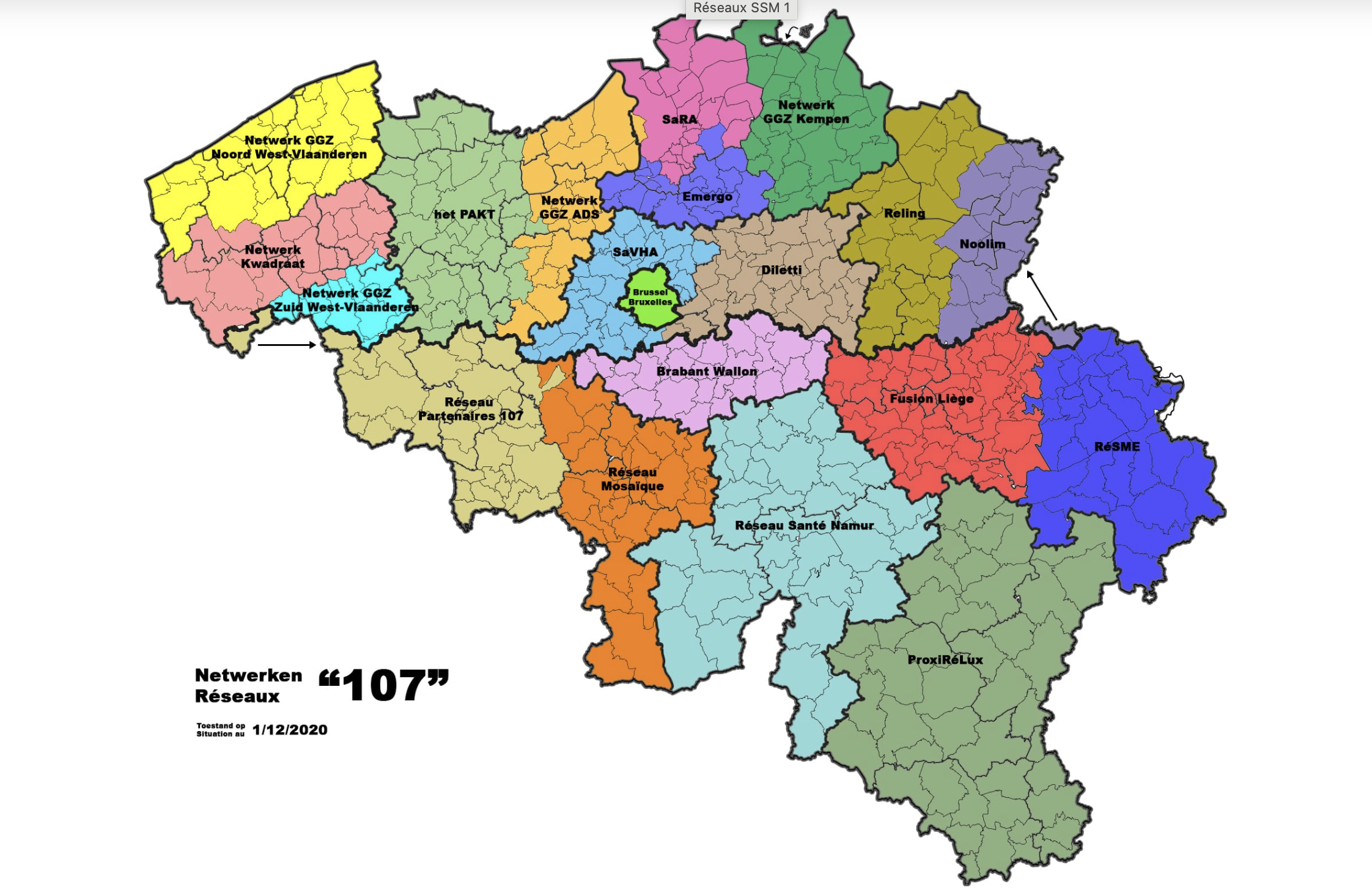
“107” Networks for Adults
The 107 system aims to provide local, human, and flexible psychological care. These networks offer short- or long-term support, mobile teams, and often therapeutic groups.
For example, PsyBru is a mental health network based in Brussels. It connects people with local professionals and services that provide psychological support — including therapy programs, crisis care, and prevention.
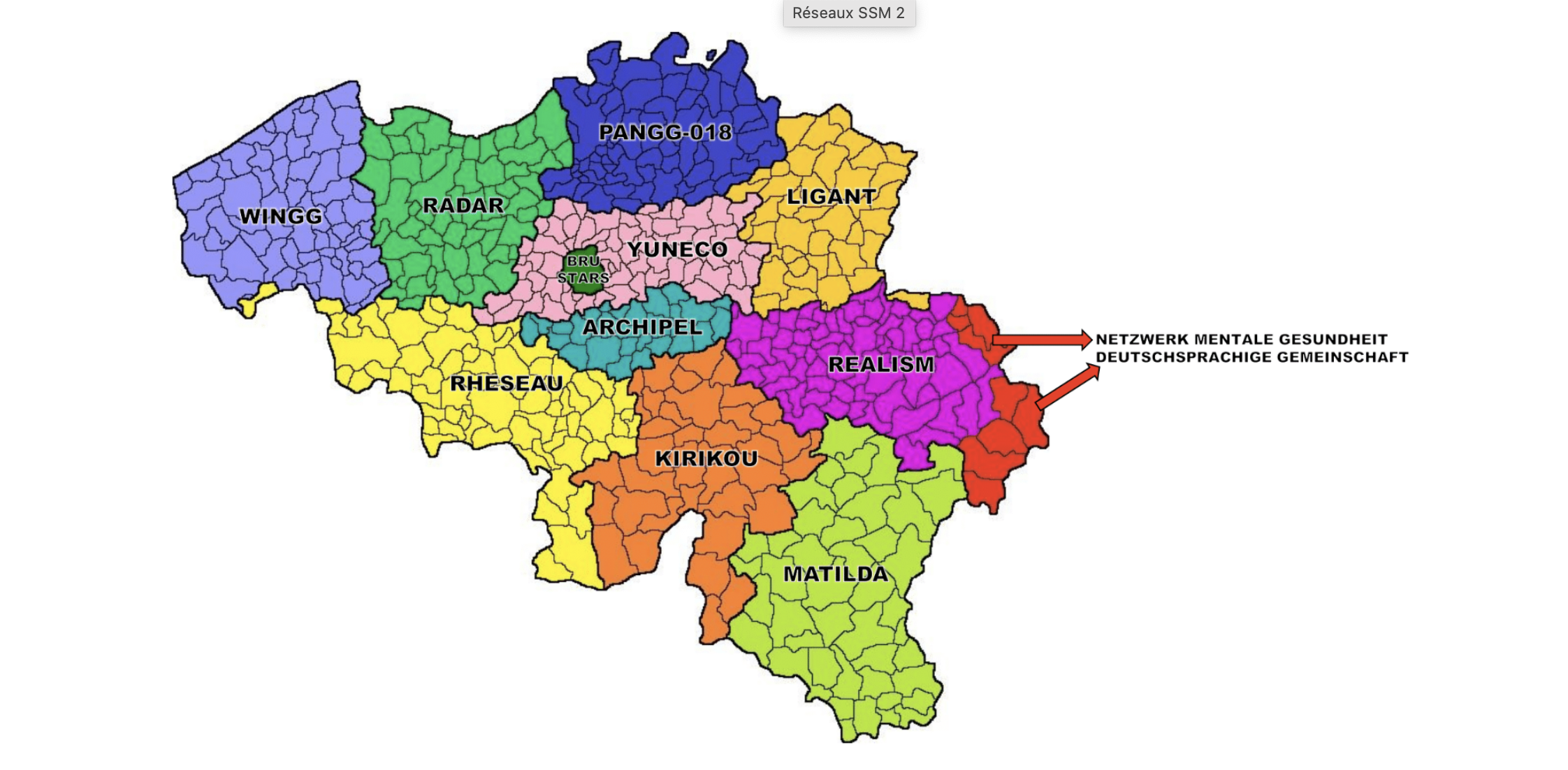
📍 Map of networks for adults
You can find your region on the map and explore available resources near you.
The maps are from the reference site psy107.be, which compiles official information about the 107 networks in French-speaking Belgium.
“107” Networks for Children and Adolescents
These networks support children, adolescents, and their families in cases of psychological difficulties.
You can find:
An initial intake meeting
Individual support for the child or adolescent
Support for parents
Sometimes family support groups
These services are public or semi-public, and accessible without a medical referral.
In addition, you can explore Kalima, a platform dedicated to circles of speech, accessible both online and in-person.
Kalima offers:
Thematic circles focused on emotional expression, parenting, and personal experiences,
Open collective spaces for everyone,
Workshops on active listening and mindful communication.
It is a complementary resource that helps you find spaces for dialogue through a preventive and caring approach.
Kalima circles are suitable for anyone seeking connection, sharing, or looking to complement a therapeutic process.
Conclusion: In Belgium, there are solutions
When going through a difficult time, the most important thing is not to stay alone.
As research shows, participating in a support group or group therapy can truly make a difference: these spaces help break isolation, allow you to share your experiences, normalize your feelings, and teach practical strategies for moving forward.
In Belgium, there are many accessible resources: public networks, support groups, group therapy led by trusted professionals… and you can explore them at your own pace.
You can already consult the groups available near you or online, and choose the one that best fits your needs.
You don’t have to have everything figured out or know exactly what you need to take this first step.
A simple action, a small gesture, can already spark change.
💛 And what if this simple article were the beginning of something new? One small step can open unexpected paths. Take your time to explore, to listen, and above all: don’t hesitate to seek support. You are not alone. 💛
Apolline, from Healing Together
NB : To go further, here are the scientific references cited:
McDermut, W., Miller, I. W., & Brown, R. A. (2001). The Efficacy of Group Psychotherapy for Depression: A Meta-Analysis and Review of the Empirical Research. Journal of Clinical Psychology, 57(4), 421–441.https://onlinelibrary.wiley.com/doi/abs/10.1002/jclp.1023
This article was created by our former collaborator, Rawya Benaissa. When screens take over We all sometimes get carried away by certain habits. With screens, it’s even easier. For young children, teens, and young adults, the phone has become a…
Who is this article for? This article is for you if you feel a bit lost, overwhelmed, or simply tired of something that keeps looping in your head. If you don’t really have the energy or desire to start a…
Every science is constantly evolving — and psychology is no exception. Almost every day, a new discovery emerges. But where do we stand with psychology today? Currently, many new fields are appearing in psychology, especially with the arrival of high-performance…