When you see your child suffering, you no longer know where to start
Sometimes you can sense that something is wrong with your child.
He or she no longer wants to go to school, has angry outbursts that you don’t recognize, complains of stomachaches with no medical cause, or stays shut away in their room all day.
You try to understand, to reassure… but you often feel alone with your questions.
Some parents come in with concerns about a recent diagnosis: ADHD, giftedness, social anxiety, depression…
Others don’t have a diagnosis — just that intuition that “something isn’t right.”
Today, there are groups that welcome these experiences:
Spaces for parents of neurodivergent children, for those facing behavioral challenges, broken connections, or invisible suffering.
Because sometimes, talking with others helps you find insights — and above all, helps you feel less alone.
And as a parent, faced with all of this, you may feel overwhelmed, powerless, worried, or even guilty.
If you are reading this, it’s probably because you recognize yourself a little in these words.
This article was written for you.
Who is this article for?
You are a parent, stepparent, or relative of a child or teen in difficulty
You are feeling powerless, guilty, exhausted — or a mix of all three
You would like to talk about what you’re going through with others who understand
You don’t know where to turn, or where to start
Why can a group really help?
When a child is struggling, it is often the whole family that suffers.
Yet we rarely think of offering support spaces for parents.
Research clearly shows that working in a group has very positive effects for parents facing complex situations with their children.
For example, a systematic review — meaning a rigorous analysis that synthesizes the results of multiple existing studies — conducted by Stewart, M., Letourneau, N., Masuda, J., Anderson, S., & McGhan, S. in 2016, from the University of Calgary (Canada), published in Child: Care, Health and Development, showed that parent support groups help to:
Reduce parental anxiety and stress
Strengthen the sense of parenting competence
Break isolation
Improve family relationships
In addition, a literature review conducted by Hoagwood, K. E., Cavaleri, M. A., Olin, S. S., Burns, B. J., Slaton, E., Gruttadaro, D., & Hughes, R., in 2010, affiliated with the New York University School of Medicine (USA), published in Administration and Policy in Mental Health and Mental Health Services Research, confirmed that these spaces help parents to:
Better understand their child’s needs
Develop appropriate coping strategies
Feel less alone in the face of everyday challenges
What types of groups exist for parents?
Support group:
A space for sharing among parents. You can talk about your worries, doubts, exhaustion — without judgment.
These groups are often led by a professional or a trained peer, and are open even if your child does not have an official diagnosis.
Group therapy:
A deeper level of support, guided by a therapist.
This type of group helps you to understand your reactions, explore the dynamics in your relationship with your child, set boundaries, and replenish your own emotional reserves.
It is not an admission of failure. It is an act of care — for your child, but also for yourself.
And what about Healing Together?
At Healing Together, we help shine a light on trusted professionals who offer support groups and group therapy on many topics — including support for parents.
These spaces, whether online or in person, give you a place to:
Express what you’re going through
Listen
Breathe
Find insights
Create connections
You don’t need to have all the answers, or to explain everything.
You come just as you are.
And that is already enough.
Public networks to guide you — for you and your child
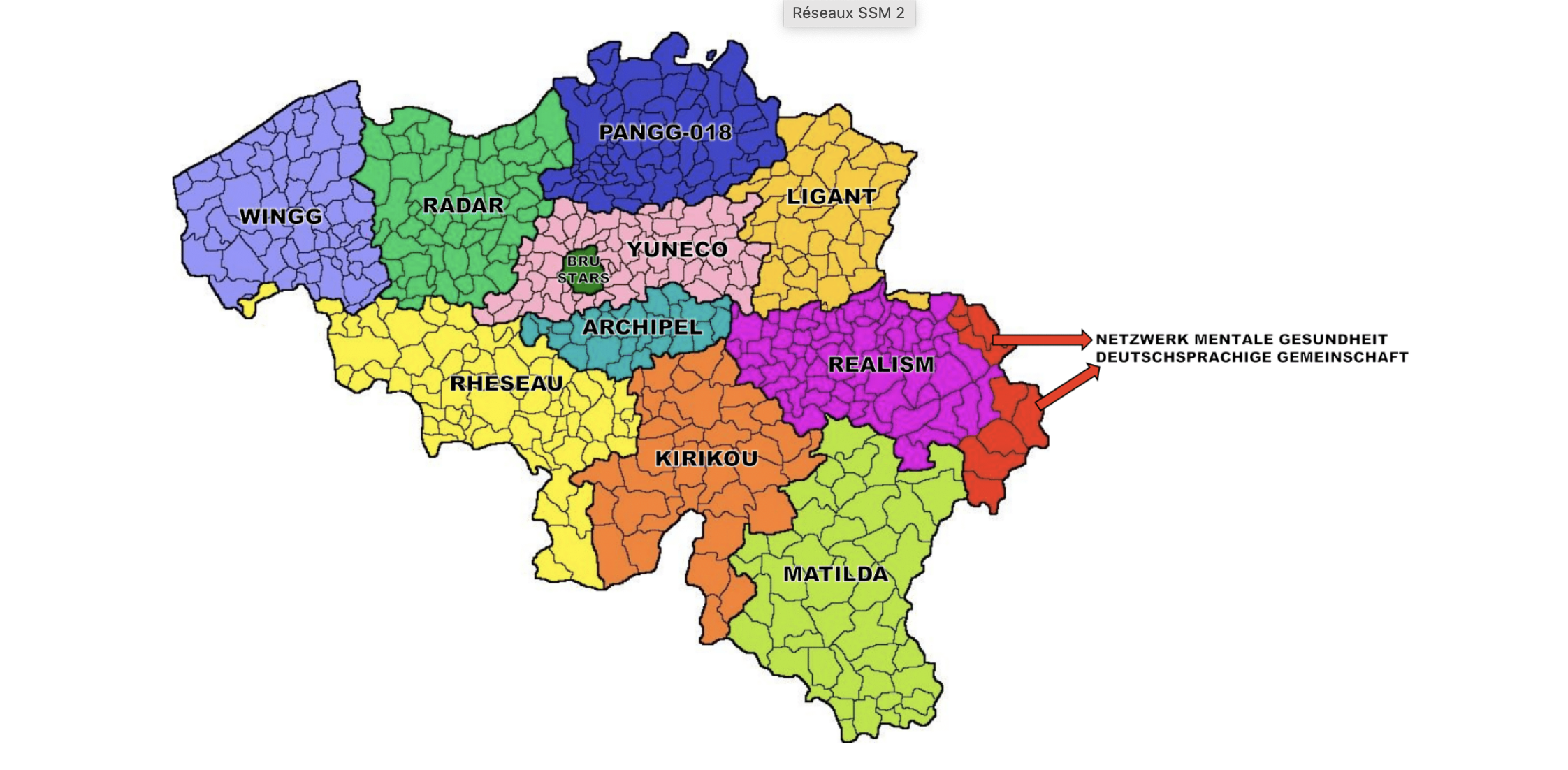
In every region of Belgium, there are mental health networks for children and adolescents.
A network is a group of professionals and services working together to support young people and their families: psychologists, educators, speech therapists, social workers — and also peer support groups, for both children and parents.
You can contact them directly, without a referral, even if you are not sure yet what type of help would be most suitable.
Here are the main networks for children and adolescents:
For example, PsyBru is a mental health network based in Brussels. It connects people with local professionals and services offering psychological support, including therapy programs, crisis care, and prevention.
💡 Click on the names — you will be redirected straight to their websites.
📍 Here is a map of the networks
Find your region and explore the services available near you.
The map shared here comes from the reference site psy107.be, which centralizes official information about the mental health networks in French-speaking Belgium.
And practically speaking — where to start?
It’s not always easy to know which type of support to choose.
Here are some ideas, depending on how you are feeling right now:
If you are feeling burned out, exhausted, or overwhelmed by daily life:
Joining a parent support group can offer a space to breathe, express what you are going through, and connect with other parents going through similar experiences.
If you want to better understand your reactions, emotions, or relationship patterns:
Group therapy led by a professional can help you explore these mechanisms in depth — and help you move forward with support.
If you are looking for help specifically for your child (anxiety, school difficulties, behavioral challenges…):
It’s best to contact your region’s youth mental health network directly.
You will find trained professionals who can support young people and families — and guide you to the right services.
Conclusion
Being the parent of a child who is struggling often means moving through uncertainty — with many questions, and few places to ask them.
We carry so much for our children — but sometimes forget to take care of ourselves.
Research shows: participating in a support group or group therapy can help break isolation, help you better understand what you are going through, allow you to share with other parents, and feel stronger to support your child.
In Belgium, there are many resources: public networks, support groups, group therapy, trained professionals… accessible without prescription and without judgment.
You can explore the available groups — near you or online — and choose the space that feels most suitable to you.
Taking that first step is not a sign of weakness.
It is an act of care — for yourself, and for your family.
💛 You deserve to be heard, supported, surrounded too. And what if this article was the start of that journey? We are here to walk it with you. 💛
Apolline, for Healing Together
NB : If you wish to consult the sources mentioned in the article, they are as follows:
Stewart, M., Letourneau, N., Masuda, J., Anderson, S., & McGhan, S. (2016). The effectiveness of peer support for parents of children with complex needs: A systematic review. Child: Care, Health and Development, 43(6), 823-830. https://pmc.ncbi.nlm.nih.gov/articles/PMC10476060/
Hoagwood, K.E., Cavaleri, M.A., Olin, S.S., Burns, B.J., Slaton, E., Gruttadaro, D., & Hughes, R. (2010). Family Support Services in Children’s Mental Health: A Review and Synthesis. Administration and Policy in Mental Health and Mental Health Services Research, 37(1-2), 73-106. https://pubmed.ncbi.nlm.nih.gov/20012893/
This article was created by our former collaborator, Rawya Benaissa. When screens take over We all sometimes get carried away by certain habits. With screens, it’s even easier. For young children, teens, and young adults, the phone has become a…
Who is this article for? This article is for you if you feel a bit lost, overwhelmed, or simply tired of something that keeps looping in your head. If you don’t really have the energy or desire to start a…
Every science is constantly evolving — and psychology is no exception. Almost every day, a new discovery emerges. But where do we stand with psychology today? Currently, many new fields are appearing in psychology, especially with the arrival of high-performance…