You sometimes feel lonely, lacking social connections, with emptiness in your days.
You wonder how to reconnect with others, how to find a space for conversation and sharing.
You want to understand how support groups or group therapy could help you.
This article is for you.
A Silent Crisis
I remember a woman I once met in a waiting room. She quietly told me: “The days are long, especially when there’s no one to tell them to.”
That sentence stayed with me. It says everything: the emptiness, the absence of connection, the feeling of slowly disappearing from others’ awareness.
Social isolation among older adults is very real.
According to the World Health Organization (WHO), one in three older adults experiences loneliness or social disconnection.
Yet it is something we rarely talk about. It’s silent, invisible… but profound.
Social Isolation vs. Loneliness: What’s the Difference?
These two terms are often confused:
Social isolation: the absence or scarcity of social contacts.
Loneliness: a subjective feeling. You can live alone and feel fine, or be surrounded by people and still feel lonely.
With age, isolation often creeps in gradually:
Loss of a spouse or friends
Retirement
Distance from family
Reduced mobility or fear of going out alone
And sometimes this vague feeling: “I no longer know how to approach others…”
I often hear: “I don’t want to bother anyone.”
And yet… everyone has the right to fully exist.
The Impact of Isolation on Mental Health
It’s not “just” sad. It’s dangerous.
The most frequent effects include:
Depression or deep emotional fatigue
Anxiety, sometimes without a clear cause
Accelerated cognitive decline
Sleep disturbances, loss of appetite
Lowered self-esteem, loss of motivation
A systematic review conducted by Kuiper et al. (2021) at Amsterdam University Medical Center (Netherlands), published in the Journal of Internal Medicine, analyzed 39 studies on the impact of social isolation on seniors.
It shows that isolation increases the risk of developing dementia by 50%.
A systematic review is a rigorous analysis of numerous studies, providing strong conclusions.
In short: isolation does not only affect mood, it also impacts memory and brain function.
Support Groups: Rebuilding Human Connection
Fortunately, there are spaces to rebuild connection, without pressure.
There are two types of groups:
Group therapy: a structured small-group process guided by a psychologist, focused on working through emotions, blocks, and relationships.
Support groups: a more flexible space, often led by a trained peer or professional, focused on sharing, listening, and connecting with others.
Both approaches are complementary:
One helps with deep personal work, the other helps to break isolation and feel less alone.
Why Are Groups So Effective?
Scientific studies show that these groups provide real benefits for older adults.
A systematic review conducted by Cattan et al. (2005) at Newcastle University (UK), published in Health Promotion International, examined the effectiveness of group interventions for isolated seniors.
The results show that these interventions help:
Reduce perceived loneliness
Strengthen the sense of belonging
Improve emotional well-being
Encourage the formation of new social ties
Additionally, Haslam et al. (2014), from the University of Queensland (Australia), demonstrated in Social Science & Medicine that participation in groups strengthens social identity, a key factor in older adults’ well-being.
Imagine…
Imagine a somewhat reserved man. He sits quietly at the edge of the circle, saying nothing.
He comes back, week after week. Then one day, he quietly says:
“I think it’s helping me, just hearing you all.”
Glances meet, smiles appear. Nothing spectacular.
But that day, something shifted.
What Can You Do Starting Today?
Start gently: a phone call, a first trial session. It’s not a commitment.
Dare to reach out: sometimes the most courageous thing is simply to try.
Remember: you fully belong here. Your words, your silences, your presence matter.
And What About Healing Together?
At Healing Together, we deeply believe that human connection is vital at any age.
We showcase:
Intergenerational or senior-dedicated support groups, online or in person
Gentle, supportive group therapies, guided by experienced professionals
You don’t have to explain everything. You come as you are, and that is enough.
You can now explore the groups available on our website.
And if the time isn’t right yet, you can sign up for our newsletter to receive updates on new groups opening.
Local Networks Are Also Here for You
In addition to the groups we highlight on Healing Together, there are public mental health networks in Belgium, open to everyone.
But what is a “network”?
A mental health network is not a single center. It is a collaborative group of professionals and services (psychologists, social workers, nurses, peer group facilitators, etc.) working together in your region to support individuals experiencing psychological distress and their families.
You can find:
Individual counseling
Support groups
Group therapies
Crisis support
Guidance to help you find the right solution for your situation
Good news: you can contact them without a medical referral, even if you’re not sure exactly what type of help you need. They are there to listen and support you.
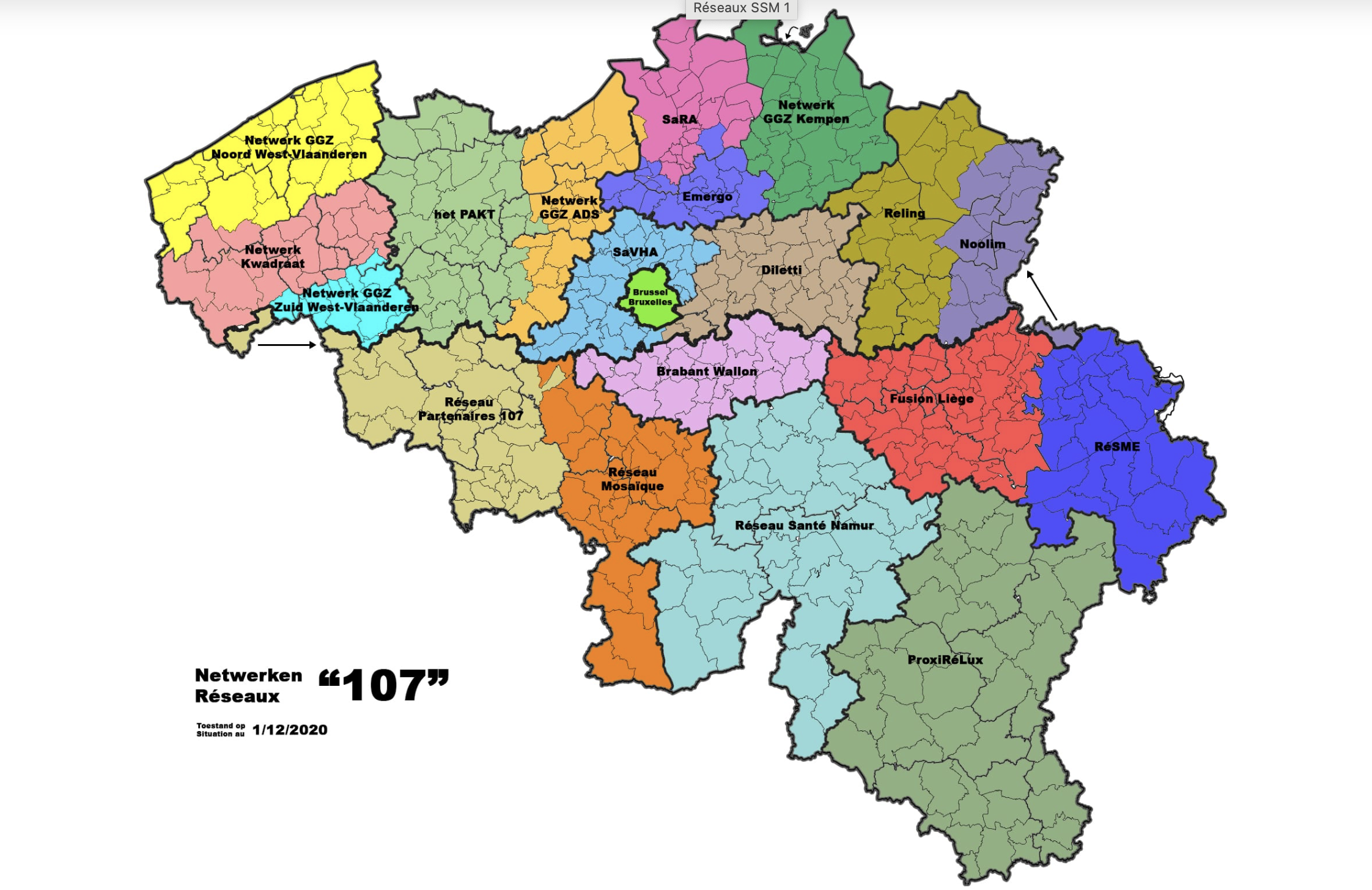
“107” Networks in French-Speaking Belgium
Here are the “107” mental health networks that can support you in Belgium:
For example, PsyBru is a mental health network based in Brussels. It connects individuals with local professionals and services offering psychological support, therapy, and crisis assistance.
📍 A Map to Help You Find Your Way
Here is a map of mental health networks in Belgium.
You can locate your region and explore the resources available near you.
The map shared here comes from the reference site psy107.be, which centralizes official information on mental health networks in French-speaking Belgium.
Other platforms to explore
In addition to the 107 networks, there are other complementary platforms that can help you find spaces for dialogue and support.
In addition, you can explore Kalima, a platform dedicated to circles of speech, accessible both online and in-person.
Kalima offers:
Thematic circles focused on emotional expression, parenting, and personal experiences,
Open collective spaces for everyone,
Workshops on active listening and mindful communication.
It is a complementary resource that helps you find spaces for dialogue through a preventive and caring approach.
Kalima circles are suitable for anyone seeking connection, sharing, or looking to complement a therapeutic process.
Conclusion – Connection Is Health
Aging does not mean disappearing.
Not from others, nor from yourself.
Joining a support group or group therapy is much more than finding a space to talk.
It is about weaving new connections, finding a rhythm again, nurturing self-esteem, and strengthening mental health.
Research shows: these are powerful tools to counter the effects of isolation and to rediscover a sense of belonging.
And it is never too late for that.
Whether you choose a group offered by Healing Together or a space within your local network, the important thing is to take this first step — your step, at your own pace.
💛 “Sometimes it just takes a look, a listening ear, an outstretched hand… to feel part of the world again. Reconnecting is already beginning to heal.” 💛
This article was created by our former collaborator, Rawya Benaissa. When screens take over We all sometimes get carried away by certain habits. With screens, it’s even easier. For young children, teens, and young adults, the phone has become a…
Who is this article for? This article is for you if you feel a bit lost, overwhelmed, or simply tired of something that keeps looping in your head. If you don’t really have the energy or desire to start a…
Every science is constantly evolving — and psychology is no exception. Almost every day, a new discovery emerges. But where do we stand with psychology today? Currently, many new fields are appearing in psychology, especially with the arrival of high-performance…