You feel stress, anxiety, loneliness, or a sense of unease
You are questioning your place in the world, your relationships, your life choices
You are looking for a space to express what you are going through, and to meet other young people navigating similar questions
I’m writing this article as if you were sitting across from me, over a cup of tea. No pressure, with kindness. To help you understand how support groups and group therapy can bring you greater well-being during this unique phase of life.
When you’re not doing that bad… but not that good either
Being 18 to 30 is often a major life passage.
Maybe you’re juggling a job and studies.
Or wondering where your life is heading, while it seems like everyone else has it figured out.
Maybe you’re going through a tough breakup, struggling to sleep, or feeling anxious as soon as you wake up.
Maybe you’re feeling overwhelmed with emotions… or, on the contrary, empty.
And yet, you haven’t dared talk about it. Maybe you tell yourself it’s “not that serious.” That you should be able to handle it on your own.
Or maybe someone has already told you: “That’s normal at your age” or “It will pass.”
But today, you are here. And that alone matters.
You don’t need things to be severe to seek support.
It’s enough that it feels too heavy for you.
In Belgium, there are many resources to help you
When you start looking for help with your mental health, it’s not always easy to navigate.
Where to begin?
Here’s a quick overview of what’s available in Belgium:
Public mental health networks (“107” networks): they offer individual support, peer groups, occasional or ongoing support — even without a diagnosis.
Local platforms: they list psychologists, therapists, and groups based on your region and needs.
Support groups and group therapy: these spaces help you avoid isolation, connect with other young people facing similar challenges, and find tools to move forward.
Why can a group really help?
Scientific research shows that support groups and group therapy are particularly helpful for young adults, especially during periods of transition and vulnerability.
For example, a systematic review — a structured, in-depth analysis of existing studies — was conducted by Keles, McCrae, and Grealish (2020) from the University of Greenwich (UK), published in Current Psychology.
This review examined 29 international studies on the effects of group-based mental health interventions for young adults (primarily university students) across various countries.
The results show that support groups and group therapy significantly reduce levels of anxiety, stress, and depressionamong young adults.
They also foster a sense of belonging, improve relationship skills, and contribute to greater emotional well-being.
In addition, a meta-analysis conducted by Pfeiffer et al. (2011), researchers at the University of Michigan (USA), published in General Hospital Psychiatry, examined the effectiveness of peer-support interventions for individuals experiencing depression.
The findings show that such interventions promote:
Sharing lived experiences
Normalizing emotions
Strengthening resilience in the face of life’s challenges
Support group, group therapy — what’s the difference?
A support group is a space for listening and sharing among people going through similar experiences (anxiety, breakups, burnout, etc.). People talk, support one another.
These groups may be led by professionals or trained peers.
Group therapy is a more structured process, led by a trained therapist.
It involves deeper exploration of emotions, relationships, and personal patterns.
Both are complementary.
One helps you not feel alone; the other helps you go deeper.
And what about Healing Together?
Healing Together is not a medical center or an emergency hotline.
It is a platform that helps promote support groups and group therapy led by trusted individuals.
We highlight groups on topics such as anxiety, high sensitivity, relationships, self-esteem…
Some groups are led by therapists, others by trained peers.
They may take place online or in person, near you.
You don’t need to have all the answers to take the first step.
What you are feeling is enough.
But wait… what is a “network”?
When we talk about a mental health network, we’re not talking about a single location.
A network is a group of professionals and services who collaborate in your region to support people experiencing psychological difficulties.
In a network, you may find:
Psychologists
Educators
Nurses
Social workers
Peer groups
And sometimes partners within schools, associations, or local services
Good news: you can contact a network even if you haven’t seen a psychologist before, or even if you don’t have a diagnosis.
They are there to listen, guide you, and help you find what might be helpful for you.
Networks exist in your region
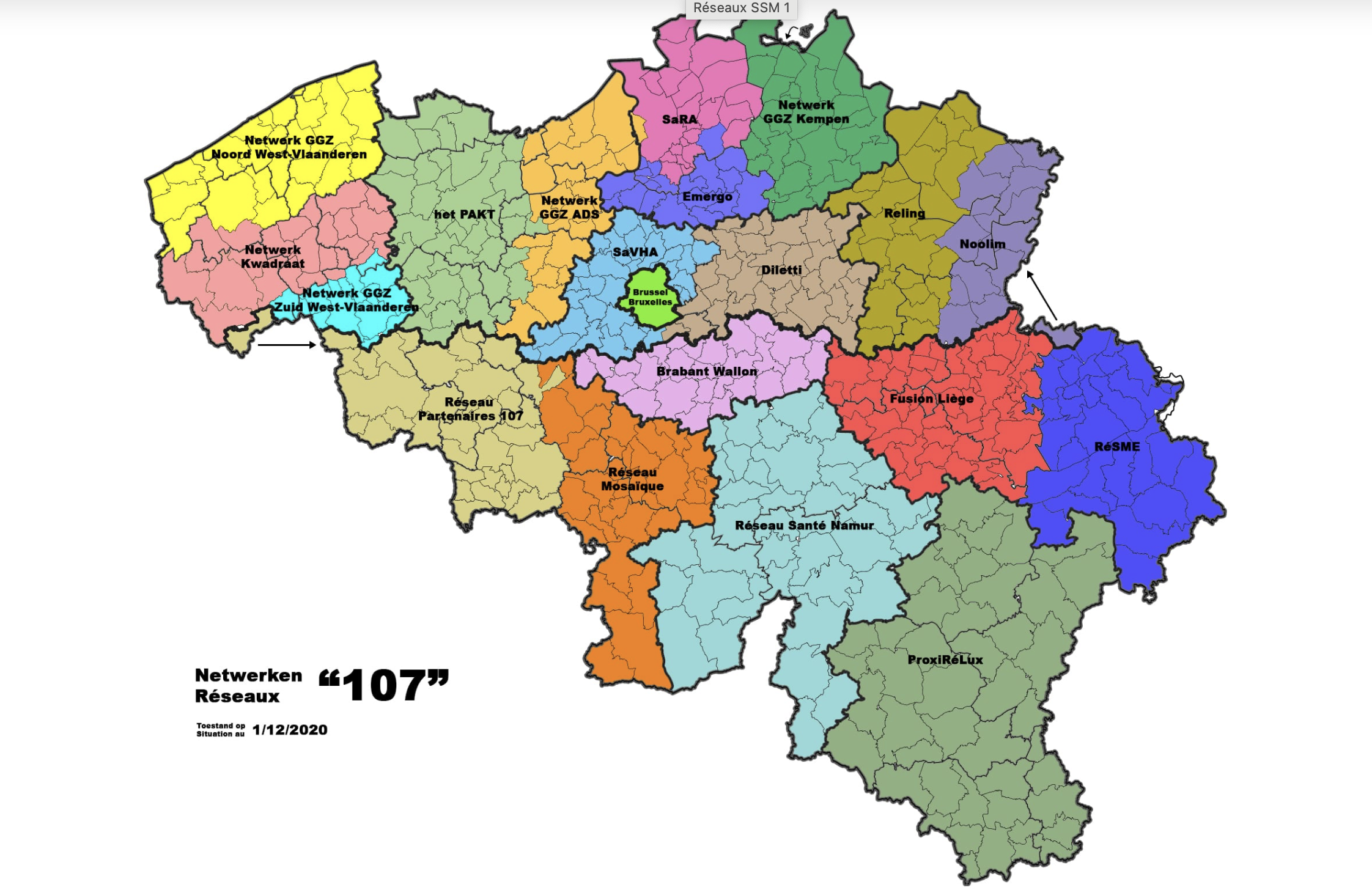
Here are the “107” networks that can support young adults in Belgium:
💡 Click on the names — you’ll be redirected to their websites.
For example, PsyBru is a mental health network based in Brussels.
It connects individuals with local professionals and services offering psychological support, therapy, and crisis services.
📍 A map to help you navigate
Here is a map of mental health networks for young adults in Belgium.
The map shared here comes from the reference site psy107.be, which centralizes official information on mental health networks in French-speaking Belgium.
Other platforms to explore
In addition to the 107 networks, there are other complementary platforms that can help you find spaces for dialogue and support.
In addition, you can explore Kalima, a platform dedicated to circles of speech, accessible online or in-person.
Kalima offers:
Thematic circles focused on emotional expression, parenting, and personal experiences,
Open collective spaces for everyone,
Workshops on active listening and mindful communication.
It is a complementary resource that allows you to explore supportive spaces through a preventive and caring approach.
Kalima circles are suitable for anyone seeking connection, sharing, or looking to complement a therapeutic journey.
What now?
Maybe you’re still wondering where to start.
That’s perfectly normal. There are many types of spaces for dialogue and support today, and everyone can find what suits them best.
If you feel the need to simply talk and share in a supportive environment, without necessarily starting a therapeutic process, you can explore the circles of speech offered by Kalima.
If you’re looking for thematic support groups or therapies led by professionals, the Brussels Platform for Mental Health (PBSM) lists many local initiatives in Brussels.
If you’d like a broader overview, the 107 networks map will help you identify mental health resources and services in your region.
Finally, if you’re seeking more individualized support, local platforms and professional directories can help you find a therapist for personalized care.
And if you’re still unsure about what might suit you best, don’t hesitate to write to us.
We’re here to listen, guide you, and help you take that first step that feels right for you.
Conclusion
You don’t need to have it all figured out, or have a diagnosis, to have the right to seek support.
The simple fact that something feels heavy is reason enough.
In Belgium, there are many resources to support young adults: public networks, support groups, group therapy, committed professionals.
You don’t have to go through this period alone.
Research shows: connecting in a group, meeting other young people going through similar experiences — that alone can help you feel better, regain confidence, and move forward.
If today you feel ready to take a first step, you can check out the available support groups and group therapy options — online or near you.
You can also explore our other articles on topics that especially affect your age group.
One step, even a small one, can change everything.
Speaking up is already starting to heal.
And don’t forget: you are not alone.
There are spaces ready to welcome you — at your pace.
💛 There are solutions, spaces, and people ready to listen — without judgment.
Speaking up is already starting to heal. 💛
Apolline, for Healing Together
NB : If you want to consult the sources mentioned in the “Why can a group really help?” section, here are:
What are the different types of group therapy in Belgium? If you’re reading this, maybe you’ve felt alone in your mental health journey — or you care deeply about someone who has. This article is for you. Whether you’re just…
This article was created by our former collaborator, Rawya Benaissa. When screens take over We all sometimes get carried away by certain habits. With screens, it’s even easier. For young children, teens, and young adults, the phone has become a…
Who is this article for? This article is for you if you feel a bit lost, overwhelmed, or simply tired of something that keeps looping in your head. If you don’t really have the energy or desire to start a…
Every science is constantly evolving — and psychology is no exception. Almost every day, a new discovery emerges. But where do we stand with psychology today? Currently, many new fields are appearing in psychology, especially with the arrival of high-performance…